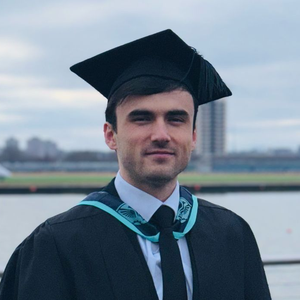
Aminjon
I am from Tajikistan
I study PhD at University of East London· United Kingdom
PhD in United Kingdom
International Lawyer
As a PhD candidate at the University of East London, I research state sovereignty in the era of globalisation. Originally from Tajikistan, I completed an LLM in International Law. Happy to answer questions about postgraduate study and research.
Ask me about
Aminjon is a former student and verified International Foundation Group ambassador
Why Aminjon chose this path
“Growing up in Tajikistan, I was acutely aware of how international law shapes the fates of small nations - trade agreements, border disputes, sovereignty questions. I wanted to understand these forces at the deepest level.”
What attracted me
The world needs rigorous, independent scholarship on the challenges facing international law in an era of rising nationalism and competing great powers. I want to contribute to that conversation.
My background before
I completed the IFG Foundation, then pursued an undergraduate degree in Law, followed by an LLM in International Law. IFG gave me the academic framework to succeed in the UK system.
How I got in
My journey from IFG Foundation to PhD took years of consistent academic work. Foundation to undergraduate, then LLM, then a PhD application focused on state sovereignty and globalisation - accepted by the University of East London.
Top tips for getting accepted
For PhD applications, your research proposal is everything. It must demonstrate an original contribution to knowledge, methodological clarity, and deep familiarity with existing scholarship. Find a supervisor whose expertise aligns precisely with your research question.
Common mistakes to avoid
Proposing research that is too broad. A PhD contribution must be specific, focused, and achievable in three to four years. Reviewers can immediately tell when a proposal lacks precision.
My recommendation to you
If you're passionate about an intellectual question, pursue it. The PhD journey is long and challenging, but the opportunity to contribute genuinely new knowledge to your field is extraordinary.
What Aminjon wishes they knew
Things I wish I knew before starting
How much the quality of your supervisory relationship determines your PhD experience. Choose your supervisor as carefully as you choose your institution.
What surprised me most
How intellectually isolating and simultaneously stimulating the PhD process is. You work alone on a unique problem, but the wider research community is generous and collaborative.
The hardest part
The uncertainty. Unlike coursework, where success is measurable, a PhD involves extended periods where you're not sure if your argument is working. Resilience is the defining quality.
The best decision I made
Choosing UEL for its internationally focused law school and a supervisor who is an expert in exactly my research area. Institutional reputation matters less than supervisory fit for a PhD.
Biggest misconception people have
That international law is theoretical and remote from real events. The opposite is true - every geopolitical development tests and reshapes international legal norms in real time.
What helped me most
Building a rigorous daily writing habit. A PhD is fundamentally a writing project. Even 500 words a day compounds into substantial progress over months.
What it's actually like
A typical day
Writing from 8am to 12 - my protected thinking and drafting time. Afternoons for reading, supervision sessions, or research seminars. Evenings for chess, documentary films, and hiking when weather allows.
The reality vs. the expectation
Mostly solitary and self-directed. A PhD is very different from taught degrees - there are no weekly deadlines, no lectures to attend, only the slow accumulation of original scholarship.
My favourite part
When an argument comes together. The moment a chapter's logic clicks into place - when evidence, theory, and analysis align - is genuinely exhilarating.
Most challenging part
The absence of external structure. Without it, discipline must be entirely internal. I maintain strict routines to prevent the PhD from expanding to fill all available time.
Where it's taken me
Skills I've gained
Advanced legal research methodology, academic writing, argumentation, comparative legal analysis, and presenting complex ideas to both academic and non-specialist audiences.
How it's helped my career
I am midway through my PhD research at UEL. My work on state sovereignty is already being discussed in my academic community.
Opportunities it has opened
Academic conference invitations, engagement with international law think tanks, and connections to researchers in Central Asian and post-Soviet legal studies.
Topics Aminjon can help with
Questions students ask Aminjon
Is a UK PhD in Law recognised internationally?
What's the hardest part of doing a PhD?
Ready to ask Aminjon a question?
